The Tragedy of Scale:
Christopher Nolan’s Odyssey and the Limits of the Screen
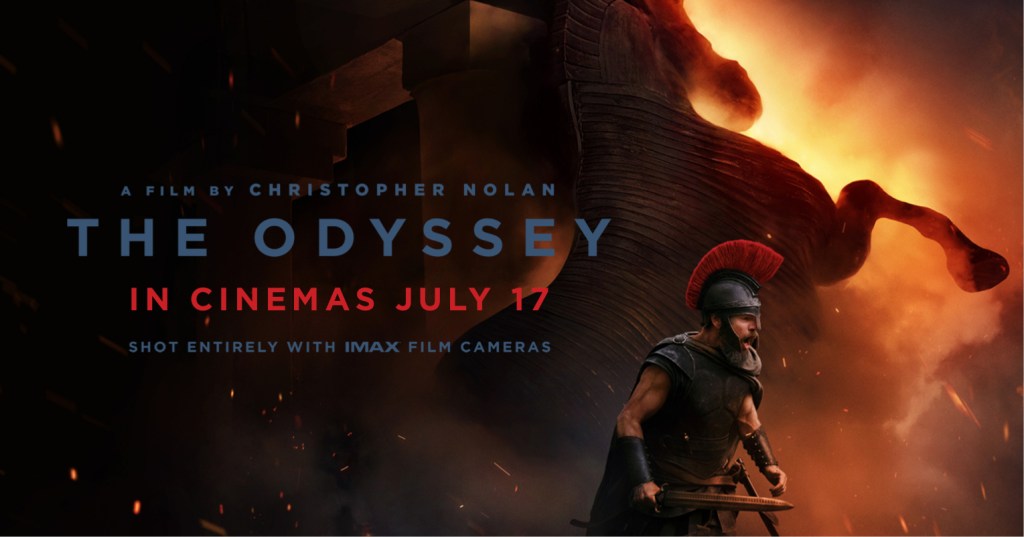
There is a moment in Christopher Nolan’s Odyssey where the real power of classic filmmaking hits you with the force of a tidal wave. It is a quiet sequence in the open sea: Odysseus looks over the edge of his ship, and a group of real, wild dolphins suddenly jumps out of the water right next to him. Learning that Nolan did not use any CGI for this sequence alters the entire viewing experience. In an era where digital effects destroy audience’s trust and make cinema feel weightless, he presents us with a masterclass in real, physical beauty, capturing wild unscripted nature across six countries. I left the theater completely overwhelmed by these terrific, panoramic landscapes, hypnotized by the central performances, and yet – profoundly frustrated by the structural architecture of the story.
Let us be honest: Matt Damon is the absolute anchor of this ship. His performance is a revelation of raw, psychological exhaustion, anchored by a physical presence that demands your total, undivided attention. Damon’s body becomes a canvas of the Trojan War’s brutality – sculpted, weathered, and possessing a commanding, magnetic sensuality that makes it impossible to look away from the screen. He carries the heavy gaze of a man haunted by trauma, yet his physical form exudes the mythic, striking strength of a Bronze Age king. Nolan brilliantly uses this Hollywood iconography only to subvert it, turning a god-like warrior into a broken soul.
The tangible reality reaches a terrifying peak during the legendary transformation on Circe’s island. In a display of incredible practical effects, the painful transformation of Odysseus’s men into pigs is captured entirely in-camera using mechanical animatronics and kinetic clay. Samantha Morton’s incredible performance as the witch turns the scene into a horrifying spectacle of physical distortion. This scene is so deeply disturbing that even Anne Hathaway and Tom Holland said in interviews with IMDb that they were totally shocked by how real the technology looked on set.
Speaking of Hathaway, she is a spectacular diamond in the crown of this cinematic masterpiece. Her Penelope fights greedy men with a breathtaking blend of tenderness and absolute iron will – a strength that easily eclipses both her teenage son and all suitors who claimed her hand . A brilliant detail here comes from costume designer Ellen Mirojnick. Dressed in majestic, colorful gowns Penelope refuses mourning. Every part of her clothes shows her strong belief that her husband is alive and every day might be the day of his return.
The primary antagonist, Robert Pattinson’s Antinous, is a pretty charismatic and dirty enemy. However, in a fascinating directorial choice, the most surrounding male performances are intentionally flattened into a background canvas designed purely to illuminate Odysseus. From Agamemnon, who never shows his face, to Odysseus’s friends – many of whom remain entirely nameless – the men function almost like shadows. Even the role of his own son, Telemachus (played by Tom Holland), was reduced to essentially “passing ammunition”. Paradoxically, but maybe exactly this calculated reduction of impact of the supporting cast that yields such a singular, towering image of the central hero.
The magnetic music by Ludwig Göransson deserves special attention. It is not a normal Hollywood soundtrack; it feels like a living thing from another world. Following Nolan’s strict rules, Göransson did not use a traditional orchestra at all. Instead, he created an authentic Bronze Age soundscape. He rebuilt ancient Greek instruments like the aulos (a twin-pipe reed instrument) and the lyre, mixing them with the heavy, echoing hits of 35 custom bronze gongs. Combined with the haunting, modern vocals of James Blake delivers a sensory experience that vibrates through your chest.
However, Odyssey is a film that breaks its own back under the weight of its ambition. Nolan, usually a master of twisting time to his will, has fallen hostage to the original myth. But Homer’s epic was never meant to be a singular, linear narrative; it is a collection of separate songs. By trying to push every single famous myth into a one theatrical release, Nolan doesn’t build a story – he constructs a monolith of material that collapses onto the audience.
By the third hour, the movie stops being an immersive journey and becomes a test of endurance. I understand that this emotional and physical exhaustion mirrors Odysseus’s own ten-year torment. But when the stakes are dialled up to eleven from the opening frame, and the narrative climax repeats itself with a dozen identical beach landings, the human brain naturally detaches. Empathy gives way to fatigue.
The deep irony of Odyssey is that despite being completely overstuffed, it leaves you starving for more. I desperately wanted the film to slow down. I wanted more to explore Odysseus’s mind and his PTSD. As a displaced Ukrainian, the painful weight of long-term separation from home is not an abstract concept to me, but a lived reality. Watching Odysseus struggle to reconnect with his world, I wanted more time dedicated to this profound trauma and his fractured relationship with Telemachus, his psychological tether to Penelope, and even the tragic, quiet loyalty of his dog, Argos, at the very end of the story.
Instead, these deeply human, emotional moments are sacrificed at the altar of the next big set-piece. Why? Because Nolan hit the literal, physical limits of his favorite medium. The giant 70mm IMAX film rolls have a hard physical limit of exactly 3 hours. Just like his previous movie Oppenheimer, the physical film reel for Odyssey weighs 600 pounds and is 11 miles long. There was simply no more room on the platter for character depth. Homer’s world required a different canvas – maybe a trilogy of movies or a high-budget TV series. Pushing all Odysseus’s adventures into one three-hour box forced Nolan to trade a profound psychological arc for structural monotony.
Still, even with its flawed pacing, Odyssey is an unforgettable landmark in cinema history.
Today, at the beginning of the AI era, when images are created by computers and text prompts, Nolan’s movie stands as a brave monument to real human work. It has flaws, it is exhausting, but it is magnificent. It is a monument to what cinema used to be and what, in the hands of a mad genius, it can still miraculously achieve.
 Iryna Pankratova
Leave a comment